
Best Seller Authors

Book Marketing, Publishing, Author Resources

  • About
  • Twitter

Aug 07 2013

Online Bookstores Gained, While Brick-and-Mortar Lost

online bookstoresBowker study says bookstore chains held less than 20 percent share in 2012 while online bookstores continued to do well.

In the year following the exit of Borders from the book retail scene, online bookstores — led by Amazon — earned 44 percent of Americans’ book dollars, up from 39 percent in 2011. The insights into where book buyers are spending come from the 2013 U.S. Book Consumer Demographics and Buying Behaviors Annual Review, the publishing industry’s only complete consumer-based report integrating channel, motivation and category analysis of U.S. book buyers. The Review, an information staple published this month by Bowker® Market Research and industry trade magazine Publishers Weekly, notes that while book retailer Barnes & Noble (including BN.com) remained the second largest bookselling outlet, it depended more on sales of print books in 2012 than it did in 2011, with consumer ebook spending there declining from six percent in 2011 to four percent.

“The Review reveals the larger industry impact of the growth of ebooks,” said Jo Henry, director of Bowker Market Research, a service of ProQuest affiliate Bowker. “This is more than simply a format change. Ebooks are driving powerful behavioral changes among book buyers. The Review captures those trends, providing greater ability to predict and prepare in a very dynamic landscape.”

The Annual Review explores who is buying books, what they’re buying, along with where and why they’re buying them and the industry changes those demographics and behaviors are driving. Information is culled from the Bowker Market Research consumer panel of almost 70,000 Americans who bought books of any format and from any source in 2012 and reveals another pivotal year in the evolution of the book industry.

Among the Review’s highlights:

· Women increased their lead over men in book buying, accounting for 58 percent of overall book spending in 2012, up from 55 percent in 2011. However, men are bigger hardcover buyers – the only area where their buying outpaces women’s.

· The slowly improving economy has improved the climate for purchasing books. By the close of 2012, 53 percent of consumers said the economy was having no effect on their book buying habits, up from 51 percent at the end of 2011.

· Ebooks continue their steady upward trend, with an 11 percent share of spending in 2012, compared to seven percent in 2011.

· The growth of ebooks varies widely among the different publishing categories with their deepest penetration focused in fiction, particularly in the mystery/detective, romance, and science fiction categories, where ebooks accounted for more than 20 percent of 2012 spending.

Despite the growth of ebooks, traditional print book output grew three percent in 2012, from 292,037 titles in 2011 to 301,642 in 2012. The Review contains Bowker’s popular breakdown of print production by genre and for “Unclassified” works comprising mostly reprints and Print-on-Demand, public domain works marketed almost exclusively on the web. This category bounced back with 11 percent growth after a steep 65 percent decline between 2010 (3.8 million titles) and 2011 (1.3 million titles). In 2012, the Reprint/POD sector accounted for the largest ISBN output – more than 1.4 million titles — and as a result, drove an overall increase in print book output of ten percent.

“The book industry continued to change in some unexpected ways in 2012,” said Jim Milliot, Publishers Weekly Editorial Director and editor of the Annual Review. “The information in the annual review is just what is needed to help all industry members adjust to the new publishing reality.”

The 2013 U.S. Book Consumer Demographics and Buying Behaviors Annual Review is available now by visiting www.bookconsumer.com. Through August, the report can be purchased for $799 for a single-use PDF or print copy. After August the price rises to $999. Members of the news media can purchase at a 30 percent discount by contacting MarketResearch@bowker.com. Print copies are being manufactured on demand by Ingram Content Group’s Lightning Source, the global leader in print on demand book manufacturing and distribution.

Written by warren · Categorized: amazon, book marketing, publishing, sell books · Tagged: online bookstores

Jun 26 2013

Book Store Death Watch: Barnes & Noble to Discontinue Nook Tablet

nook deadBarnes & Noble will no longer produce new tablet devices as it transitions to a “partnership model” on color tablets, the company announced today in its fourth-quarter and full-year earnings report. The company also announced greater than expected losses for the quarter of $122 million or $2.11 per share on $1.3 billion in revenue.

Investors expected sales to fall to $1.33 billion and a loss of $0.99 cents per share for the quarter. For the full year, the company’s results weren’t much better, following a disastrous holiday quarter in which it became apparent that Nook tablet sales were struggling. Revenues decreased 4.1% to $6.8 billion versus 2012. The company’s earnings before interest, taxes, depreciation, and amortization (EBITDA) was $10.3 million versus $176.7 million a year ago. Overall, the company’s net losses were $154.8 million, or $2.97 per share, as compared to $65.6 million, or $1.35 per share in 2012.

Barnes & Noble shares are down about 15% in early trading.

“Going forward, the company intends to continue to design e-reading devices and reading platforms, while creating a partnership model for manufacturing in the competitive color tablet market,” the company wrote in today’s earnings release. “Thus, the widely popular lines of Simple Touch™ and Glowlight™ products will continue to be developed in house, and the company’s tablet line will be co-branded with yet to be announced third party manufacturers of consumer electronics products.”

Full Story on Digital Book World site

See full story on digitalbookworld.com

Photo by Jeremy Greenfield

Written by warren · Categorized: book marketing · Tagged: e-reader, nook

May 28 2013

How the Google Books Settlement Changes the Future of Reading

google books

From io9 on the Future of Reading due to Google Books

If you care about the future of books, you need to understand the Google Book Settlement. It’s a complicated legal document, but we’ve talked to some of its architects, detractors, and defenders – and break it all down for you.

The Google Book Settlement could easily be the twenty-first century’s most important shift in how we deal with copyright in the world of publishing. To understand it, you need a little back story on the previous giant shift in copyright law, which happened about twelve years ago.

Mickey Mouse Protection Act

In 1998, copyright was turned on its head by a piece of legislation often called the “Mickey Mouse Protection Act.” Known to policy-makers as the Copyright Extension Act, it was the result of intensive lobbying by the entertainment industry, led in part by Disney, to extend the copyright on any work created after 1923. Many of Disney’s classic pieces of content, like Mickey Mouse cartoons, were about to pass into the public domain. So the company was naturally interested in keeping control of the Mouse as long as it could.

The Copyright Term Extension Act was good for authors’ estates, and for corporations. Under the new rules, copyright would become life of the author plus 70 years – and for works of corporate authorship, 120 years after creation. (Previously, copyright had been life of the author plus 50 years, with 75 years for corporate works.)

The Act also gave birth to a loosely-organized but powerful movement of copyright reformists. Led by activists, scientists, artists, and tech nerds, this movement has stretched from university campuses to the Supreme Court of the United States, where law professor Lawrence Lessig argued that the Copyright Extension Act was unconstitutional because it violated the First Amendment (SCOTUS didn’t buy it). Over the past decade, many of these reformists migrated to jobs in Silicon Valley, where easily-copied digital media are constantly forcing the question of what copyright really means in the information age.

One might say that the Google Book Settlement (GBS) is the result of this migration. One of the basic injunctions of copyright reform is “share your culture,” and the seeds of the GBS come from an admirable Google project aimed at sharing the knowledge from research liaries with the world.

Many years ago the search company began digitizing the books from several university liaries, pulling every single book from the shelves and making a digital copy. The idea was to make hard-to-access texts available to anyone, not just people lucky enough to live near a major research school. Via Google Book Search, people would be able to search for keywords in the full text of any book, then read one or two-sentence “snippet” excerpts from it. The Mickey Mouse Protection Act may have stalled the growth of the public domain, but the company’s Google Book Search project would oaden it.

The Settlement

The Google Book Search project was conceived as an online liary, its texts fully searchable, and open to all. Unfortunately, when you digitize everything in a liary, a lot of books are swept up in the frenzy. Among the rare and out-of-print works Google digitized were millions of copyrighted works. When publishers and authors of those works got wind of Google’s project, some of them sued for infringement. They didn’t want any parts of their books available online for free – they wanted people to pay for them.

See full story on io9.com

Image courtesy of io9.com

Written by warren · Categorized: book marketing

May 13 2013

Online Retailers, E-books Continue to Grow Ahead of Traditional Publishing and Bookstores

e-textbooks
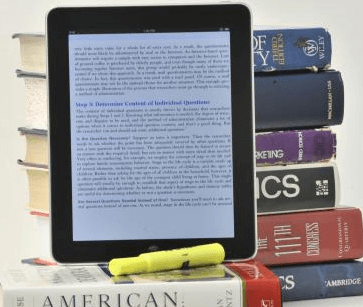
Some schools are now forcing students to use e-textbooks.

E-books captured 11% of all book spending last year, up from 7% in 2011, Kulo reported, while e-books accounted for 22% of units in 2012, up from 14% the prior year. In 2010, e-books accounted for only 2% of spending. Despite the gains made by digital, paperback remained the most popular format last year, accounting for 43% of spending, down one percentage point from 2011, while hardcovers represented 37% of dollar sales, down from 39%.

The growth in the e-book format last year was one of the factors that increased e-commerce’s lead as the largest channel for book sales, Kulo noted. Online retailers, led by Amazon, accounted for 44% of sales in 2012, up from 39% in 2011. The gains made by online retailers came at the expense of bookstore chains, whose market share fell to 19%, from 26% in 2011. As consumers buy more e-books they also tend to buy more print books from the same outlet—a trend that has cemented Amazon’s position as the country’s largest booksellers, Kulo said. According to the Bowker data, Amazon captured 31% of dollars spent on all books last year, up from 26% in 2011. Despite the chains’ loss of market share, they were the only other channel besides online retailers to have a slice of the book market that was bigger than 10%. Together, chains and online retailers accounted for 63% of spending in the year, up from 56% in 2009. Independent bookstores had a 6% share of spending in the year, the same as in 2011.

Kulo also noted that the Kindle remained the most popular reading device among e-book buyers in 2012, although some members of the Kindle family gained share while others lost ground. Kindle e-ink devices fell from a 43% share in 2011 to 40% last year, but the percentage of e-book buyers who reported owning a Kindle Fire, released in fall 2011, rose to 20% in 2012, from a low base the prior year. Despite a bad holiday season, Nook was used by 15% of e-book buyers last year—the same level as in 2011. Ownership of iPads remained relatively low among e-book buyers at 19%, up from 15% in 2011. The Kindle family, by a wide margin, was also the most popular group of devices used by e-book buyers to download e-books in 2012, with 55% of the e-book buyers using either the e-ink or tablet versions. The Nook, which held second place, was used by 14%. Tablets, including iPads, came in third at 13%.

More data relating to buying trends and consumer book-buying behavior will be included in the upcoming edition of the 2013 U.S. Book Consumer Demographics and Buying Behaviors Annual Review, to be published by Bowker in June.

See full story on publishersweekly.com

Written by warren · Categorized: book marketing, e-book, sell books · Tagged: amazon best seller, online promotion, online retailers, publishing future

May 12 2013

Best Selling Author Named Power Influencer Top 10 by Forbes

Las Vegas: Best Selling Author Warren Whitlock, publisher of this blog and others has been named a “Forbes top 10 social media power influencer”

Forbes Top Influencer Warren Whitlock
Forbes Top Influencer

Whitlock, active online for the last 32 years, best-selling author, speaker and serial entrepreneur in publishing, advertising and marketing consulting and more commented “I am always happy to be acknowledged by these lists. None of these accolades suggest that there’s some competition and a winner but it’s nice to be included with colleagues that I know are helping business take advantage of the revolution in marketing that we currently call social media

“Social media tools that we have today have helped to enable a change from the 20th-century model of doing business where a centralized organization could push out a marketing message to the masses, limited only by the large budgets it took to communicate one way

“thanks to the Internet and especially these tools, consumers have the expectation that communications will be two-way conversations. Those businesses that learn to implement this in every part of their business will see their best years ever while those who continue to try to control a message and push consumers into old models will go downhill.”

Best Selling Author

Whitlock is the best selling author butof two books on social media, including the first book about Twitter and mobile marketing “Twitter Revolution: How Social Media and Mobile Marketing are Changing the Way We Do Business” and “Profitable Social Media: Business Results without Playing Games”

Written by warren · Categorized: book marketing

  • 1
  • 2
  • 3
  • …
  • 52
  • Next Page »

Copyright © 2026 · Altitude Pro Theme on Genesis Framework · WordPress · Log in