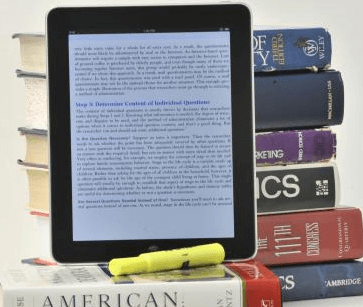
Some schools are now forcing students to use e-textbooks.
E-books captured 11% of all book spending last year, up from 7% in 2011, Kulo reported, while e-books accounted for 22% of units in 2012, up from 14% the prior year. In 2010, e-books accounted for only 2% of spending. Despite the gains made by digital, paperback remained the most popular format last year, accounting for 43% of spending, down one percentage point from 2011, while hardcovers represented 37% of dollar sales, down from 39%.
The growth in the e-book format last year was one of the factors that increased e-commerce’s lead as the largest channel for book sales, Kulo noted. Online retailers, led by Amazon, accounted for 44% of sales in 2012, up from 39% in 2011. The gains made by online retailers came at the expense of bookstore chains, whose market share fell to 19%, from 26% in 2011. As consumers buy more e-books they also tend to buy more print books from the same outlet—a trend that has cemented Amazon’s position as the country’s largest booksellers, Kulo said. According to the Bowker data, Amazon captured 31% of dollars spent on all books last year, up from 26% in 2011. Despite the chains’ loss of market share, they were the only other channel besides online retailers to have a slice of the book market that was bigger than 10%. Together, chains and online retailers accounted for 63% of spending in the year, up from 56% in 2009. Independent bookstores had a 6% share of spending in the year, the same as in 2011.
Kulo also noted that the Kindle remained the most popular reading device among e-book buyers in 2012, although some members of the Kindle family gained share while others lost ground. Kindle e-ink devices fell from a 43% share in 2011 to 40% last year, but the percentage of e-book buyers who reported owning a Kindle Fire, released in fall 2011, rose to 20% in 2012, from a low base the prior year. Despite a bad holiday season, Nook was used by 15% of e-book buyers last year—the same level as in 2011. Ownership of iPads remained relatively low among e-book buyers at 19%, up from 15% in 2011. The Kindle family, by a wide margin, was also the most popular group of devices used by e-book buyers to download e-books in 2012, with 55% of the e-book buyers using either the e-ink or tablet versions. The Nook, which held second place, was used by 14%. Tablets, including iPads, came in third at 13%.
More data relating to buying trends and consumer book-buying behavior will be included in the upcoming edition of the 2013 U.S. Book Consumer Demographics and Buying Behaviors Annual Review, to be published by Bowker in June.
Authors need to have a tribe to read what they write.
Publishers don’t build tribes, they print and distribute books. This business model has served them well in the past when there were limits on ways authors could reach readers. All authors and publishers would do well to study Tribes
Seth announced his intentions on his blog
Authors need publishers because they need a customer. Readers have been separated from authors by many levels–stores, distributors, media outlets, printers, publishers–there were lots of layers for many generations, and the editor with a checkbook made the process palatable to the writer. For ten years, I had a publisher as a client (with some fun self-published adventures along the way). Twelve bestsellers later, I’ve thought hard about what it means to have a traditional publisher.
Traditional book publishers use techniques perfected a hundred years ago to help authors reach unknown readers, using a stable technology (books) and an antique and expensive distribution system.
The thing is–now I know who my readers are. Adding layers or faux scarcity doesn’t help me or you. As the medium changes, publishers are on the defensive…. I honestly can’t think of a single traditional book publisher who has led the development of a successful marketplace/marketing innovation in the last decade. The question asked by the corporate suits always seems to be, “how is this change in the marketplace going to hurt our core business?” To be succinct: I’m not sure that I serve my audience (you) by worrying about how a new approach is going to help or hurt Barnes & Noble.
We know that publisher can still serve an author. If you have build a two way dialog with your tribe (say, you are on TV but have never blogged) then a large check from someone betting on your title to click with their distribution is a no-brainer.
Seth has been teaching us to build a tribe for years. Now he’s broke ties with the old model that used to serve him. No doubt he’ll do well.
What’s your strategy to build a two way dialog with your readers?
New technology will combine eye tracking, always online connections and what we know about the way people read to create Text 2.0 .. text that changes to help you read better.
The most amazing thing about this short video is that there is no technology used that is not currently available today. Everything shown can be done now.
With the pace of technology speeding along as it does, I imagine we’ll be seeing this in a very short time in ebook readers and books of the future
I just received an email from Apple announcing that I could buy an iPad now for delivery next month.
What’s odd about this?
Apple doesn’t spam me. I get receipts from iTunes and an occasional holiday reminder that an iPod makes a great holiday gift. While I’m sure they have many lists for various customer bases, as a light user of Apple products, this is the first time I’ve received a pre-release advertisement to buy an Apple Product.
So much hype over an evolutionary step forward.. the technology is just a larger screen iPod/iPhone with many limitations compare to tablet computer and similar sized laptops… I think this is one more signal that the smart guys are planning for another upturn in the move to ubiquitous devices everywhere.
When you get used to carrying whatever devices add value to your life, there is less and less room for a book in your bag.. especially when the reading experience becomes better than reading ink on paper.
Most of the publishing world desperately hangs on to any thread of the old way of doing things. Many bookstores, publishers and many authors are convinced that Google and Amazon are out to put them out of business.
As part of the settlement, Google will not show any part of in-copyright books online that are not included under its new “partner program,†according to Google chief legal officer David Drummond.
At the same time, Drummond claims that the settlement will help to boost Google’s scanning of books, and allow it “to begin offering in-copyright, out-of-print books for preview and sale directly online,†MarketWatch wrote. Google has already made more than 7 million books available to Internet users, and Drummond said, “We’re just getting started.â€
The settlement also tasks Google with creating the Book Rights Registry, an independent nonprofit service meant to “resolve outstanding claims by authors and publishers and to cover legal fees from class-action lawsuits against Google,†The Daily Telegraph reported.
I take a different point of view. Readers ultimately are the market. We want to get our information in whatever form we like, whenever and wherever we desire.
The market for books will not go away, but the institutions that cling to the past are doomed. I do hope the stores come up with a good reason for us to shop there.. I do like strolling through the shelves.. but the won’t survive if they just fight progressTechnorati Tags: book marketing, publishing future, bookstores


 As part of the settlement, Google will not show any part of in-copyright books online that are not included under its new “partner program,†according to Google chief legal officer David Drummond.